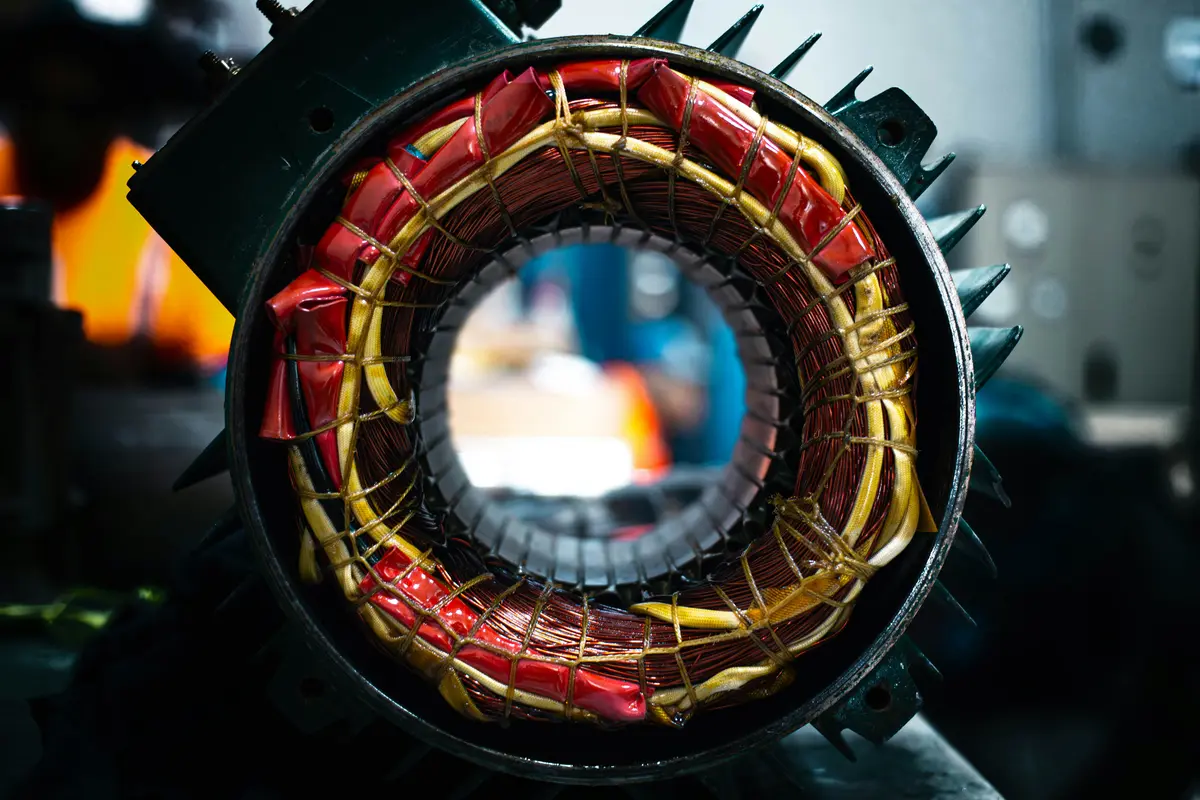


Understanding Induction Motors: Working Principle, Calculations, and Applications
- Admin: IDAR Mohamed
- 22 Oct 2024
- 0
Induction motors, the practical cornerstone of modern industry, power everything from household appliances to large industrial machinery. Their robustness, simplicity, and efficiency make them a preferred choice for a wide range of applications.
This post explores how induction motors work, presents key equations, and includes practical examples with diagrams and tables for enhanced understanding.
1. Basics of Induction Motors
An induction motor (or asynchronous motor) operates on the principle of electromagnetic induction. It has two main parts:
- Stator: The stationary part, consisting of laminated steel cores and windings connected to the AC supply, which creates a rotating magnetic field.
- Rotor: Typically a squirrel-cage structure made of conductive bars short-circuited by end rings, it rotates due to the induced current.
2. How Induction Motors Work
Step-by-step operation:
- AC Supply to Stator: An alternating current applied to stator windings creates a rotating magnetic field.
- Induction in Rotor: According to Faraday's Law, this magnetic field induces an EMF in the rotor conductors.
- Current Flow in Rotor: The induced EMF drives current through the rotor.
- Torque Production: The interaction between the stator's magnetic field and rotor current produces torque, causing the rotor to rotate.
3. Key Equations and Calculations
a. Synchronous Speed ()
Where:
- : Synchronous speed (RPM)
- : Supply frequency (Hz)
- : Number of poles
Example: For a 4-pole motor on a 50 Hz supply:
b. Slip ()
Where:
- : Rotor speed (RPM)
Example: If rotor speed RPM:
c. Rotor Frequency ()
Example: With , Hz:
d. Power Output ()
Where:
- : Torque (Nm)
Example: RPM, Nm
e. Efficiency ()
Example: W, W
💡 Note: If efficiency is above 100%, it indicates incorrect assumptions or measurement error.
4. Practical Applications
Induction motors are used in:
- 🏠 Home appliances: Washing machines, air conditioners, refrigerators
- 🏭 Industrial machinery: Pumps, conveyors, compressors
- 🚈 Transportation: Electric trains, trams
- 🌬️ HVAC systems: Blowers, fans
5. Example Problem
Problem:
A 4-pole, 3-phase induction motor runs on 50 Hz supply. The rotor speed is 1440 RPM at full load. The motor delivers 25 Nm torque and takes 4 kW input power. Calculate:
- Synchronous speed
- Slip
- Rotor frequency
- Output power
- Efficiency
Solution:
a. Synchronous speed:
b. Slip:
c. Rotor frequency:
d. Output Power:
e. Efficiency:
6. Table: Performance Summary
| Parameter | Value |
|---|---|
| Synchronous Speed | 1500 RPM |
| Rotor Speed | 1440 RPM |
| Slip | 4% |
| Rotor Frequency | 2 Hz |
| Power Output | 3770 W |
| Power Input | 4000 W |
| Efficiency | 94.25% |
Conclusion
Induction motors are vital to industrial and domestic applications. Understanding their physics, calculations, and performance factors allows engineers to better design, optimize, and troubleshoot real-world systems.
Want help choosing or calculating the right induction motor for your system?
📩 Contact us or explore our other detailed posts in electrical engineering.
Credits
-
Photo by Troy Winther on Unsplash
⭐ Was this article helpful?
IDAR Mohamed
Electrical Engineer
Electrical Engineer specialized in power systems, electrical installations, and energy efficiency. Passionate about simplifying complex electrical concepts into practical guides. (University of applied sciences graduate, with experience in HV/LV systems and industrial installations.)
- Induction Motors
- Motors
- Energy Conversion
- Electrical Machines
- Motor Applications