

Star Delta Starter: Complete Wiring Guide with Timer Calculations & Troubleshooting
- Admin: IDAR Mohamed
- 02 Nov 2025
- 0
Star delta starters are a common way to start three-phase induction motors, particularly in the 5–200 HP range. The windings connect in star at startup, then switch to delta once the motor reaches operating speed. That single step cuts starting current by around 33% — enough to prevent inrush from stressing the motor or overloading the supply.
This guide covers the wiring, settings, and theory you'll need, whether you're doing a fresh installation, tracking down a fault, or choosing between contactor and timer options.
Table of Contents
- Understanding Star Delta Starting Principles
- Star Delta Starter Components
- Star Delta Wiring Diagrams
- Timer Settings and Calculations
- Component Selection Guide
- Installation and Commissioning
- Troubleshooting Common Problems
Understanding Star Delta Starting Principles
What is Star Delta Starting?
Star delta starting is a reduced voltage starting method for three-phase induction motors. The motor starts with its windings connected in star (Y) configuration, which applies reduced voltage to each winding. Once the motor reaches approximately 80-90% of rated speed, the connection automatically switches to delta (Δ) configuration for normal full-power operation.
Why Use Star Delta Starting?
Key Benefits:
| Advantage | Star Delta | Direct-On-Line (DOL) |
|---|---|---|
| Starting Current | 2-3 times FLA | 6-8 times FLA |
| Starting Torque | 33% of DOL | 100% of rated |
| Mechanical Stress | Reduced significantly | High impact |
| Supply System Impact | Minimal voltage dip | Severe voltage dip |
| Cost | Moderate | Low |
| Complexity | Medium | Simple |
Star vs Delta Connection Theory
Star Connection (Y) - Starting Phase:
- Each winding receives line voltage divided by √3 (approximately 58%)
- Voltage per winding:
- Current per winding equals line current:
- Starting current:
- Starting torque:
Delta Connection (Δ) - Running Phase:
- Each winding receives full line voltage
- Voltage per winding:
- Current per winding:
- Full rated torque and current
Practical Example: For a 30 HP motor at 415V:
- DOL starting current: 180A (6 times FLA of 30A)
- Star delta starting current: 60A (2 times FLA)
- Current reduction: 67%
When to Use Star Delta Starters
Ideal Applications:
- Centrifugal pumps with low starting torque requirements
- Fans and blowers
- Compressors with unloaded start
- Conveyors starting empty
- Machine tools with light initial load
Not Suitable For:
- High starting torque loads (conveyors, crushers)
- Motors with single voltage rating
- Applications requiring frequent starts
- Very small motors (below 5 HP) - cost not justified
- Motors that must accelerate quickly under load
⚡ Working on similar calculations?
Get practical electrical tips and quick answers like this — straight to your inbox.
Star Delta Starter Components
Essential Components
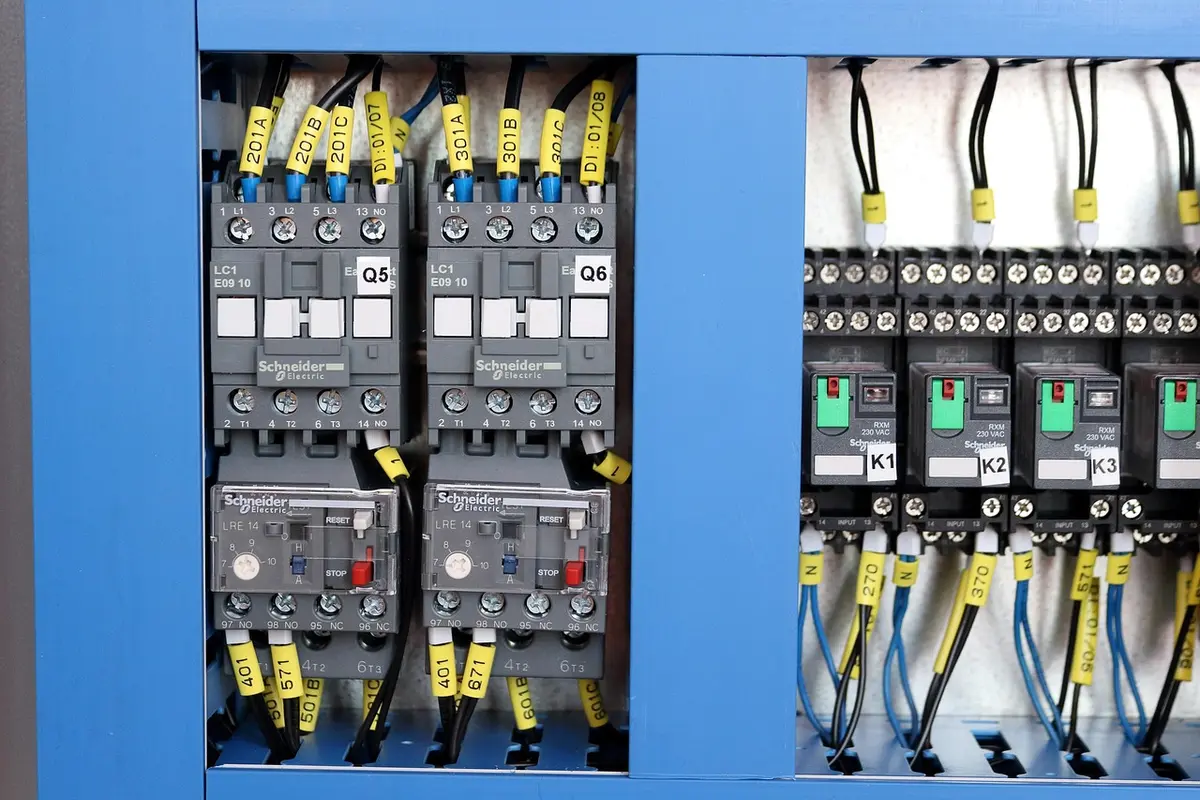
A complete star delta starter system consists of several key components working together:
1. Main Contactor (KM3 - Delta Contactor)
- Carries full motor current during normal operation
- Must be rated for motor full load amperes (FLA)
- Typically largest contactor in the system
- Closes after star contactor opens
2. Star Contactor (KM1)
- Connects motor windings in star configuration
- Can be smaller than main contactor (58% rating)
- Opens before delta contactor closes
- Active only during starting sequence
3. Line Contactor (KM2)
- Controls power supply to motor
- Rated same as main contactor
- Remains closed during entire operation
- First to close, last to open
4. Star Delta Timer Relay
- Controls transition timing from star to delta
- Adjustable delay typically 5-30 seconds
- Critical for proper motor acceleration
- Available in electronic or mechanical versions
5. Overload Relay
- Protects motor from overcurrent
- Set to motor nameplate FLA
- Thermal or electronic types available
- Must trip all three phases
6. Control Circuit Components
- Push buttons (START/STOP)
- Indicator lights (power, running, fault)
- Auxiliary contactors for interlocking
- Fuses or MCBs for control circuit protection
Component Rating Selection
For a 30 HP motor at 415V (FLA = 42A):
| Component | Rating | Selection Criteria |
|---|---|---|
| Main Contactor (Delta) | 50A (AC3) | 1.2 × FLA minimum |
| Star Contactor | 32A (AC3) | 0.58 × Main contactor |
| Line Contactor | 50A (AC3) | Same as main contactor |
| Overload Relay | 30-42A adjustable | Set to motor FLA |
| Star Delta Timer | 5-15 seconds | Based on motor acceleration |
| Control Fuses | 2A | For 230V control circuit |
Star Delta Wiring Diagrams
Power Circuit Wiring
The power circuit connects the three-phase supply to the motor through the contactors:
Standard Power Circuit Configuration:
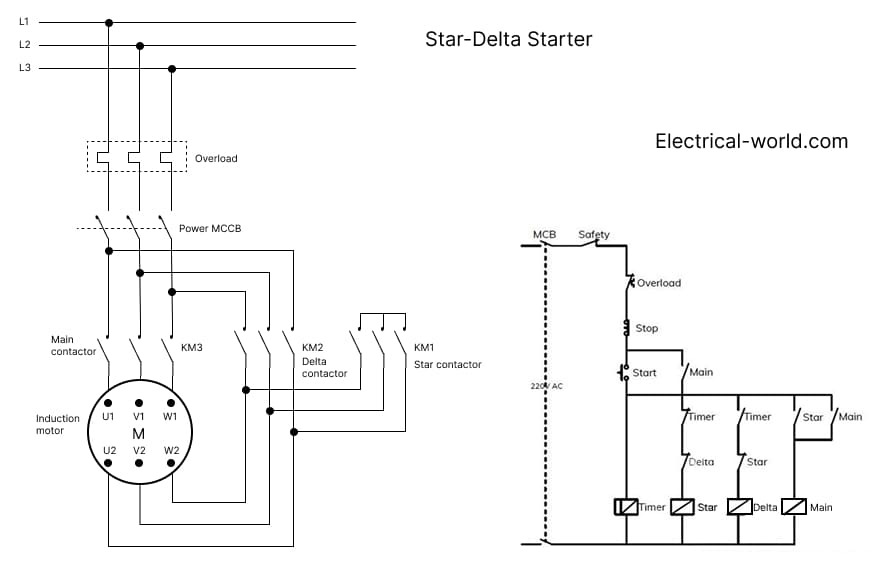
Complete Star-Delta starter diagram showing both high-voltage power circuit and low-voltage control/command circuit. Three-phase supply (L1, L2, L3) feeds the line contactor (KM2) and main contactor (KM3) to motor terminals U1, V1, W1. Star contactor (KM1) connects the motor star point U2, V2, W2. The low-voltage control circuit includes start/stop pushbuttons and control coils for KM1, KM2, and KM3 to manage the star-delta switching and reduce starting current.
Motor Terminal Connections:
- U1, V1, W1: Start of each phase winding (delta terminals)
- U2, V2, W2: End of each phase winding (star point)
During Star Starting:
- KM2 (Line) closes: Connects supply to U1, V1, W1
- KM1 (Star) closes: Shorts U2, V2, W2 together (star point)
- Motor runs in star configuration
After Timer Delay:
- KM1 (Star) opens: Breaks star point connection
- Brief pause (0.05-0.1 seconds)
- KM3 (Delta) closes: Connects U2→V1, V2→W1, W2→U1
- Motor runs in delta configuration
Control Circuit Wiring
The control circuit manages the starting sequence and provides interlocking:
Basic Control Logic:
- START button pressed: Energizes line contactor (KM2) and star contactor (KM1)
- Timer starts: Begins countdown when star contactor closes
- Timer expires: De-energizes star contactor, energizes delta contactor
- Interlocking: Prevents simultaneous star and delta connection
- STOP button: De-energizes all contactors
Critical Interlocking Requirements:
- Star and delta contactors must never close simultaneously
- Mechanical and electrical interlocking required
- Time delay between star opening and delta closing (typically 50-100ms)
warning
⚠️ Safety Warning: Simultaneous closure of star and delta contactors creates a direct short circuit between phases, causing severe equipment damage and potential electrical arc flash. Always implement both mechanical and electrical interlocking.
Typical Wiring Schematic
Power Circuit:
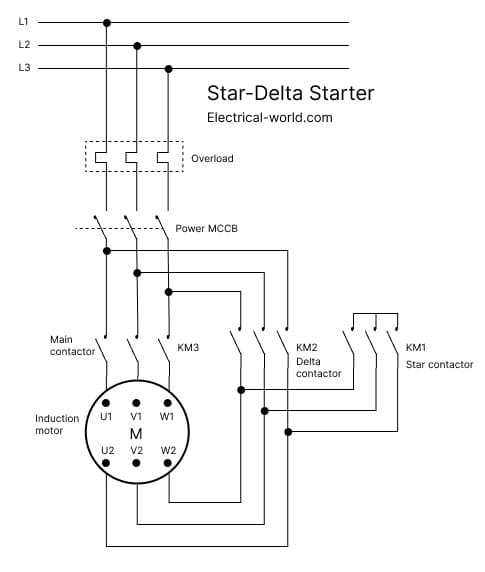
Star-Delta starter diagram showing 3-phase supply (L1, L2, L3) feeding a line contactor (KM2), then a main contactor (KM3) to motor terminals U1, V1, W1. Star contactor (KM1) connects the motor star point terminals U2, V2, W2, reducing starting current for three-phase motors.
Timer Settings and Calculations
Determining Optimal Timer Setting
The star delta timer delay must allow the motor to reach sufficient speed (typically 80-90% of rated RPM) before switching to delta. Setting the timer too short causes high current spikes during transition, while setting it too long wastes energy and may overheat the motor in star connection.
Calculation Method
Step 1: Determine Motor Acceleration Time
The acceleration time depends on motor and load inertia:
Where:
- = Total moment of inertia (kg·m²)
- = Rated speed (RPM)
- = Average accelerating torque (N·m)
Step 2: Calculate Star Connection Time
The timer should be set to approximately:
This allows the motor to reach 80-90% of rated speed in star before switching to delta.
Practical Timer Settings by Motor Size
Based on typical applications (pumps, fans):
| Motor Power | Typical Timer Setting | Acceleration Characteristics |
|---|---|---|
| 5-10 HP | 5-7 seconds | Quick acceleration, light load |
| 10-20 HP | 7-10 seconds | Moderate acceleration |
| 20-50 HP | 10-12 seconds | Standard industrial loads |
| 50-100 HP | 12-15 seconds | Heavy loads, higher inertia |
| Above 100 HP | 15-20 seconds | Very high inertia systems |
Timer Adjustment Procedure
Initial Setting:
- Set timer to middle of recommended range
- Start motor and observe current during transition
- Monitor motor speed using tachometer if available
Adjustment Criteria:
Timer Too Short (increase setting):
- High current spike during star-delta transition
- Motor stutters or hesitates during switching
- Overload relay trips during transition
- Supply voltage dips significantly
Timer Too Long (decrease setting):
- Motor reaches full speed before transition
- Excessive heat in motor during star operation
- Inefficient starting process
- Unnecessary delay in reaching full power
Optimal Setting Indicators:
- Smooth transition from star to delta
- Current spike during transition less than 1.5 × FLA
- Motor at 85-90% of rated speed before switching
- No overload trips or voltage dips
Schneider Star Delta Timer Configuration
Popular Schneider Electric timer relays for star delta applications:
RE7 Series:
- Adjustable delay: 0.1-30 seconds
- DIN rail mounting
- LED indication
- Control voltage: 24-240V AC/DC
RE9 Series:
- Multi-function timer
- Digital display
- Precise adjustment
- Memory backup
Typical Settings:
- Function: Star delta (Y-Δ)
- Star time: 8-12 seconds (adjustable)
- Interlock time: 50-100ms
- Control voltage: Match panel supply
Component Selection Guide
Contactor Selection Criteria
AC3 vs AC4 Duty Ratings
Contactors are rated based on utilization categories:
AC3 Rating (Normal Starting):
- For motors with standard starting (star delta, normal conditions)
- Switching occurs at approximately 1 times motor FLA
- Longer electrical life
- Use for main and line contactors in star delta starter
AC4 Rating (Heavy Duty):
- For frequent starting, plugging, inching
- Switching at 5-6 times motor FLA
- Shorter electrical life but handles severe duty
- Generally not required for star delta starting
Contactor Sizing Example
For 45 HP Motor at 415V (FLA = 60A):
Main Contactor (Delta - KM3):
- Required current: 60A continuous
- Selected rating: 75A (AC3)
- Example: Schneider LC1D80 or Siemens 3RT1044
Star Contactor (KM1):
- Required current: 60A × 0.58 = 35A
- Selected rating: 50A (AC3)
- Example: Schneider LC1D50 or Siemens 3RT1036
Line Contactor (KM2):
- Required current: 60A continuous
- Selected rating: 75A (AC3)
- Same as main contactor
Overload Relay Selection
Motor Protection Settings:
The overload relay must be set to protect the motor without nuisance tripping:
Setting Range:
- Minimum: 0.95 × Motor FLA
- Maximum: 1.05 × Motor FLA
- Typical: Exactly at motor nameplate FLA
Class Selection:
- Class 10: Standard starting (trips in 10 seconds at 6× setting)
- Class 20: Heavy starting loads (trips in 20 seconds at 6× setting)
- Class 30: Very heavy starting (trips in 30 seconds at 6× setting)
For star delta starters, Class 10 is typically adequate since starting current is already reduced.
Complete Component List
For 30 HP Motor at 415V (FLA = 42A):
| Component | Specification | Quantity | Example Model |
|---|---|---|---|
| Main Contactor | 50A, AC3, 415V, 3-pole | 1 | Schneider LC1D50 |
| Star Contactor | 32A, AC3, 415V, 3-pole | 1 | Schneider LC1D32 |
| Line Contactor | 50A, AC3, 415V, 3-pole | 1 | Schneider LC1D50 |
| Overload Relay | 30-42A, Class 10 | 1 | Schneider LRD340 |
| Timer Relay | 0-30s adjustable, Y-Δ | 1 | Schneider RE7PA11BU |
| Start Button | Green, NO contact | 1 | XB4BA31 |
| Stop Button | Red, NC contact | 1 | XB4BA42 |
| Running Indicator | Green LED, 415V | 1 | XB4BVB3 |
| Fault Indicator | Red LED, 415V | 1 | XB4BVB4 |
| MCB | 63A, C-curve, 3-pole | 1 | For motor protection |
| Control Fuses | 2A, for 230V circuit | 2 | Control circuit protection |
Installation and Commissioning
Pre-Installation Checks
Before wiring and energizing the star delta starter:
Motor Verification:
- Check nameplate: Confirm dual voltage rating (e.g., 380V/660V)
- Verify connections: Motor terminals U1, V1, W1, U2, V2, W2 accessible
- Insulation test: Megger test shows minimum 2MΩ at 500V DC
- Mechanical check: Motor rotates freely, bearings in good condition
Component Verification:
- Contactor ratings: Match calculated requirements
- Overload relay: Set to motor FLA
- Timer range: Covers required delay period
- Control voltage: Matches available supply (230V or 110V)
Wiring Procedure
Step-by-Step Installation:
1. Mount Components:
- Install contactors and relays on DIN rail
- Maintain adequate spacing for heat dissipation
- Allow access for maintenance
2. Wire Power Circuit:
- Connect incoming supply to line contactor (KM2)
- Wire line contactor output to main and star contactors
- Connect main contactor to motor terminals U1, V1, W1
- Connect star contactor to motor terminals U2, V2, W2
- Install jumpers between contactors for delta connection
3. Wire Control Circuit:
- Connect control voltage supply (typically 230V)
- Wire STOP button (NC contact) in series
- Wire START button (NO contact) for control initiation
- Connect timer relay with proper interlock logic
- Install contactor auxiliary contacts for self-holding
4. Install Protection:
- Mount overload relay in series with motor
- Connect overload NC contact to break control circuit
- Install control circuit fuse or MCB
- Add indicator lights for status
Initial Commissioning
Pre-Energization Tests:
1. Visual Inspection:
- Verify all connections tight and secure
- Check wire sizing appropriate for current
- Confirm no loose strands or exposed conductors
- Verify mechanical interlocking in place
2. Continuity Tests:
- Check control circuit continuity with power OFF
- Verify contactor coils not short-circuited
- Test overload relay continuity
- Confirm timer relay connections
3. Insulation Tests:
- Megger test between phases: >2MΩ
- Megger test phase to ground: >2MΩ
- Test at 500V DC for 1 minute
Start-Up Procedure:
1. Initial Power-On:
- Energize control circuit first
- Check indicator lights function
- Verify stop button breaks circuit
- Test start button initiates sequence (with motor supply OFF)
2. First Motor Start:
- Set timer to mid-range (10 seconds)
- Press START button
- Observe star contactor closes (motor starts in star)
- Verify timer begins counting
- Observe transition to delta after timer expires
- Motor should continue running in delta
- Press STOP button and verify motor stops
3. Current Measurement:
- Use clamp meter on each phase
- Record starting current in star: Should be 2-3 × FLA
- Record current during transition
- Record running current in delta: Should equal FLA
- Verify balanced currents across all three phases
4. Timer Optimization:
- Adjust timer based on motor acceleration
- Repeat starts with different timer settings
- Find setting with smoothest transition
- Document final timer setting
Troubleshooting Common Problems
Problem 1: Motor Won't Start
Symptoms:
- No response when START button pressed
- Control circuit not energizing
Possible Causes & Solutions:
| Cause | Diagnosis | Solution |
|---|---|---|
| Control fuse blown | Check continuity of control fuses | Replace fuse, investigate overcurrent cause |
| STOP button stuck | Test STOP button continuity (should be closed) | Replace or repair STOP button |
| Overload relay tripped | Check overload relay status indicator | Reset overload, check motor current draw |
| Control voltage missing | Measure voltage at control terminals | Check control transformer or MCB |
| Contactor coil open | Measure coil resistance | Replace faulty contactor |
Problem 2: High Current During Star-Delta Transition
Symptoms:
- Large current spike when switching from star to delta
- Lights dim during transition
- Overload occasionally trips during switching
Possible Causes:
1. Timer Set Too Short:
- Motor hasn't reached sufficient speed
- Solution: Increase timer setting by 2-3 seconds
- Verification: Monitor motor speed, should be 85-90% before transition
2. Heavy Load:
- Motor loading too high for star delta starting
- Solution: Consider soft starter or reduce initial load
- Verification: Check if load can be started unloaded
3. Transition Delay Too Short:
- Insufficient time between star opening and delta closing
- Solution: Verify interlock timing (50-100ms recommended)
- Verification: Measure with oscilloscope if possible
Problem 3: Motor Overheats in Star Connection
Symptoms:
- Motor body hot to touch during starting
- Thermal overload trips during start sequence
Possible Causes:
1. Timer Set Too Long:
- Motor running in star beyond necessary time
- Solution: Reduce timer setting
- Target: Motor should reach 80-90% speed, then switch
2. Excessive Starting Time:
- Motor cannot reach speed in star configuration
- Solution: Verify motor design suitable for star delta
- Alternative: Consider soft starter or DOL with larger supply
Problem 4: Contactors Chatter or Buzz
Symptoms:
- Audible buzzing from contactors
- Contactors vibrate excessively
Possible Causes:
| Cause | Solution |
|---|---|
| Low control voltage | Verify control voltage at least 85% of rated value |
| Shading coil damaged | Replace contactor or repair shading ring |
| Contactor cores dirty | Clean contactor faces, remove dust and debris |
| Loose connections | Tighten all control circuit connections |
| Undervoltage during starting | Check supply voltage, consider larger supply cables |
Problem 5: Motor Runs in Star But Won't Switch to Delta
Symptoms:
- Motor starts and runs in star configuration
- Timer expires but delta contactor doesn't close
- Motor continues running in star (reduced power)
Possible Causes:
1. Delta Contactor Failure:
- Diagnosis: Check delta contactor coil voltage when timer expires
- Solution: Replace delta contactor if coil or contacts faulty
2. Interlock Issue:
- Diagnosis: Verify star contactor fully opens before delta closes
- Solution: Check auxiliary contacts, adjust interlock timing
3. Timer Relay Failure:
- Diagnosis: Measure output contact closure
- Solution: Replace timer relay
Problem 6: Frequent Overload Trips
Symptoms:
- Overload relay trips regularly during normal operation
- Motor appears to run normally before trip
Possible Causes & Solutions:
1. Overload Set Too Low:
- Check: Verify overload setting matches motor FLA
- Solution: Adjust overload relay to motor nameplate current
2. Motor Overloading:
- Check: Measure actual motor current with clamp meter
- Solution: Reduce mechanical load or upgrade motor size
3. Voltage Imbalance:
- Check: Measure voltage on all three phases
- Solution: Correct supply system voltage imbalance (should be <2%)
4. Single-Phasing:
- Check: Verify three-phase supply at motor terminals
- Solution: Check for blown fuse or open contactor contact
Advanced Considerations
Star Delta vs Other Starting Methods
Comparison with alternative reduced voltage starting methods:
| Method | Starting Current | Starting Torque | Cost | Complexity | Best For |
|---|---|---|---|---|---|
| Star Delta | 2-3 × FLA (33% of DOL) | 33% of DOL | Moderate | Medium | Light to moderate loads, 5-200 HP |
| Soft Starter | 2-4 × FLA (adjustable) | 30-80% (adjustable) | High | Low | Smooth acceleration, precise control |
| Auto-Transformer | 1.7-4 × FLA | 50-80% of DOL | High | High | High torque requirements |
| DOL | 6-8 × FLA | 100% | Low | Simple | Small motors, strong supply |
| VFD | 1-1.5 × FLA | 150%+ at low speed | Very high | Medium | Variable speed, energy savings |
Schneider Electric Star Delta Solutions
Schneider Electric offers complete star delta starter solutions:
TeSys U Line:
- Integrated motor starters
- Built-in star delta logic
- Compact design
- Motor sizes: 0.09-75 kW
TeSys D Contactors:
- Modular contactor system
- AC3 duty rated
- Mechanical and electrical life optimization
- Wide range: 9A to 800A
TeSys LR Overload Relays:
- Thermal overload protection
- Class 10, 20, or 30
- Trip indication
- Manual or automatic reset
PLC Integration
Modern installations often use PLCs for motor control:
PLC Control Advantages:
- Flexible timer adjustment without hardware changes
- Data logging of starts, run hours, trip events
- Remote monitoring and control
- Integration with plant SCADA systems
- Advanced diagnostics and predictive maintenance
Basic PLC Logic for Star Delta:
When START:
  - Activate Line Contactor (KM2)
  - Activate Star Contactor (KM1)
  - Start Timer

When Timer Expires:
  - Deactivate Star Contactor (KM1)
  - Wait Interlock Time (100ms)
  - Activate Delta Contactor (KM3)

When STOP:
  - Deactivate all contactors
- Reset timerConclusion: Mastering Star Delta Motor Starting
Star delta starters remain one of the most cost-effective and reliable methods for starting medium to large three-phase induction motors. By reducing starting current to approximately one-third of direct-on-line starting while maintaining adequate starting torque for most applications, star delta starters protect electrical systems and extend motor life.
Key Takeaways:
- Current Reduction: Star delta starting reduces starting current from 6-8 times FLA to just 2-3 times FLA
- Proper Motor Selection: Only works with motors having dual voltage ratings (delta at line voltage)
- Timer Critical: Set timer to allow motor to reach 80-90% speed before switching (typically 5-15 seconds)
- Component Sizing: Main contactor at motor FLA, star contactor can be 58% of main rating
- Interlocking Essential: Never allow star and delta contactors to close simultaneously
- Application Limits: Best for centrifugal loads (pumps, fans) with low starting torque requirements
Whether you're installing a Schneider star delta starter, troubleshooting an existing system, or designing a new motor control panel, understanding these fundamental principles ensures reliable, safe operation. Always verify motor suitability, properly size components, set timer correctly, and implement robust interlocking to prevent failures.
For motors requiring higher starting torque or more precise control, consider alternatives like soft starters or VFDs, but for the majority of pump and fan applications in the 5-200 HP range, star delta starting provides an optimal balance of performance, reliability, and cost.
🔗 Related Posts
- Understanding Induction Motors: Working Principle, Calculations, and Applications
- PLC Programming Basics: Complete Beginner's Guide
- Contactor vs Relay: Complete Guide with Applications & Selection Criteria
- Variable Frequency Drive (VFD): Complete Guide to Working Principles
- Motor Cable Size for 5 HP & 10 HP: Complete Selection Guide
- Motor Overload Protection: Complete Sizing Guide
- 3-Phase Power Calculation: Complete Guide with kW to Amps Formulas
Helpful Calculators
- Ohm's Law Calculator
- Voltage Drop Calculator
- Power Factor Calculator
- Capacitor and Inductor Reactance Calculator
Credits
⭐ Was this article helpful?
IDAR Mohamed
Electrical Engineer
Electrical Engineer specialized in power systems, electrical installations, and energy efficiency. Passionate about simplifying complex electrical concepts into practical guides. (University of applied sciences graduate, with experience in HV/LV systems and industrial installations.)
- Star-Delta Connection
- Motor Control
- PLC Programming