

3-Phase Power Calculation: Complete Guide with kW to Amps Formulas & Motor Load Examples
- Admin: IDAR Mohamed
- 28 Oct 2025
- 0
Understanding how to calculate 3-phase power is essential for electrical engineers, technicians, and anyone working with industrial electrical systems. Whether you're sizing circuit breakers, selecting motor starters, or designing power distribution systems, accurate 3-phase power calculations ensure safe and efficient operation. This guide provides the formulas, examples, and practical tips you need to confidently calculate 3-phase power, convert between kW and amps, and determine motor current requirements.
Understanding 3-Phase Power Fundamentals
Why 3-Phase Power?
Three-phase power systems offer significant advantages over single-phase:
- Higher power capacity with smaller conductors
- More efficient power transmission
- Smoother power delivery to motors and equipment
- Better voltage regulation under varying loads
- Lower conductor costs for the same power level
Key 3-Phase Power Relationships
| Parameter | Symbol | Unit | Description |
|---|---|---|---|
| Real Power | P | kW (kilowatts) | Actual work performed |
| Apparent Power | S | kVA (kilovolt-amperes) | Total power including reactive |
| Reactive Power | Q | kVAR (kilovolt-amperes reactive) | Non-working power |
| Power Factor | PF | --- (decimal or %) | Ratio of real to apparent power |
| Line Voltage | Volts | Phase-to-phase voltage | |
| Line Current | Amperes | Current in each conductor |
Essential 3-Phase Power Formulas
Basic Power Calculation
The fundamental formula to calculate 3-phase power:
Where:
- = Power in watts (divide by 1000 for kW)
- = 1.732 (constant for balanced 3-phase)
- = Line-to-line voltage
- = Line current
- = Power factor (typically 0.8 to 0.95)
Example:
- Voltage: 480V
- Current: 100A
- Power Factor: 0.85
Apparent Power (kVA) Calculation
When power factor is unknown or you need total capacity:
Example:
Power Factor Relationship
From the example above:
Converting kW to Amps (3-Phase)
Standard Conversion Formula
To convert kilowatts to amperes in a 3-phase system:
Step-by-Step Example
Given:
- Power: 50 kW
- Voltage: 480V (3-phase)
- Power Factor: 0.90
Step 1: Apply the formula
Step 2: Calculate denominator
Step 3: Complete calculation
⚡ Working on similar calculations?
Get practical electrical tips and quick answers like this — straight to your inbox.
Quick Reference: kW to Amps Conversion Table
Common 480V 3-phase conversions (at 0.85 PF):
| Power (kW) | Current (Amps) | Typical Application |
|---|---|---|
| 10 kW | 14.1 A | Small machinery |
| 20 kW | 28.2 A | Compressors, pumps |
| 30 kW | 42.3 A | Industrial equipment |
| 50 kW | 70.5 A | Large motors |
| 75 kW | 105.7 A | Heavy machinery |
| 100 kW | 141.0 A | Industrial systems |
3-Phase Motor Current Calculation
Motor Full Load Current Formula
For 3-phase motors, the full load amperage (FLA) calculation includes efficiency:
Where:
- HP = Motor horsepower
- 746 = Conversion factor (watts per HP)
- η = Motor efficiency (decimal)
- PF = Motor power factor
Complete Motor Calculation Example
Motor Specifications:
- Rating: 75 HP
- Voltage: 460V
- Efficiency: 93% (0.93)
- Power Factor: 0.88
Step 1: Calculate motor input power
Step 2: Calculate current
Motor Sizing Quick Reference
Standard motor currents at 460V:
| Motor HP | Typical FLA | Breaker Size | Wire Size (Cu) |
|---|---|---|---|
| 10 HP | 14 A | 20-25 A | 12 AWG |
| 25 HP | 34 A | 50 A | 8 AWG |
| 50 HP | 65 A | 100 A | 4 AWG |
| 75 HP | 96 A | 150 A | 2 AWG |
| 100 HP | 124 A | 200 A | 1/0 AWG |
Practical Calculation Examples
Example 1: Industrial Compressor System
Scenario: Size the electrical supply for a 40 HP air compressor
Given:
- Motor: 40 HP, 480V, 3-phase
- Efficiency: 91%
- Power Factor: 0.86
Solution:
Calculate current:
Electrical Requirements:
- Full Load Current: 48.2A
- Circuit Breaker: 70A (per NEC 430.52)
- Wire Size: 6 AWG copper minimum
- Overload Protection: 53-60A range
Example 2: HVAC System Load Analysis
Scenario: Calculate total current for HVAC equipment
Equipment:
- Chiller: 60 kW
- Air handlers: 15 kW
- Pumps: 10 kW
- Total: 85 kW
System Parameters:
- Voltage: 480V, 3-phase
- Combined Power Factor: 0.88
Calculate total current:
Installation Requirements:
- Main disconnect: 200A
- Feeder wire: 1 AWG copper
- Conduit: 2-inch minimum
Common Calculation Mistakes to Avoid
Mistake 1: Using Phase Voltage Instead of Line Voltage
Wrong:
Correct:
Always use line-to-line voltage (480V, not 277V phase voltage).
Mistake 2: Forgetting the √3 Factor
Wrong:
Correct:
The 1.732 factor is essential for 3-phase calculations.
Mistake 3: Ignoring Power Factor
Wrong: Assuming PF = 1.0
Correct: Using actual PF = 0.85
This 17.6% difference affects wire sizing and breaker selection.
Mistake 4: Confusing kW and kVA
Remember:
- Equipment ratings often in kVA (transformers, generators)
- Load calculations typically in kW
- Conversion: kW = kVA × Power Factor
Voltage-Specific Calculation Shortcuts
480V Systems (Most Common Industrial)
Quick formulas at 480V:
Current from kW:
kW from current:
208V Systems (Commercial)
Quick formulas at 208V:
Current from kW:
Power Quality Considerations
Impact of Poor Power Factor
Low power factor increases current requirements:
| Load (kW) | PF = 0.95 | PF = 0.85 | PF = 0.75 | Current Increase |
|---|---|---|---|---|
| 50 kW | 61 A | 68 A | 77 A | +26% (0.95 to 0.75) |
| 100 kW | 121 A | 136 A | 154 A | +27% |
Benefits of Power Factor Correction:
- Reduced current requirements
- Smaller conductor sizes
- Lower energy costs
- Improved voltage regulation
Harmonic Effects
Non-linear loads (VFDs, computers) can increase current by 10-20% due to harmonics. Consider derating:
Conclusion: Mastering 3-Phase Calculations
Accurate 3-phase power calculations are fundamental to electrical system design and operation. By understanding the key formulas for calculating power, converting between kW and amps, and determining motor currents, you can properly size electrical equipment, ensure code compliance, and maintain system reliability.
Key Takeaways:
- Always use the √3 factor (1.732) in balanced 3-phase calculations
- Use line-to-line voltage, not phase voltage
- Include power factor in all real-world calculations
- Account for efficiency when calculating motor currents
- Verify calculations with nameplate data when available
- Apply safety margins per NEC requirements (125% for continuous loads)
For complex installations or critical applications, consult with a licensed electrical engineer to verify calculations and ensure all applicable codes and standards are met. Remember that proper calculations are the foundation of safe, efficient electrical system design.
Ready to apply these calculations? Check out our related guides on transformer sizing, circuit breaker selection, and motor control for comprehensive electrical system design.
🔗 Related Posts
- Understanding Induction Motors: Working Principle, Calculations, and Applications
- 3 Phase Generators: How They Work and Their Applications
- Transformer Sizing: Complete Guide with Calculations, Charts & Selection Criteria
- Wire Size Calculator: Complete Guide with Single Phase, 3-Phase & DC Calculations
- Power Factor Correction: Complete Guide with Calculators, Cost Analysis & Real Savings
- Circuit Breaker Sizing: Complete Guide with Wire Size Charts & NEC Code Requirements
Helpful Calculators
- Ohm's Law Calculator
- Power Factor Calculator
- Voltage Drop Calculator
- Capacitor and Inductor Reactance Calculator
Credits
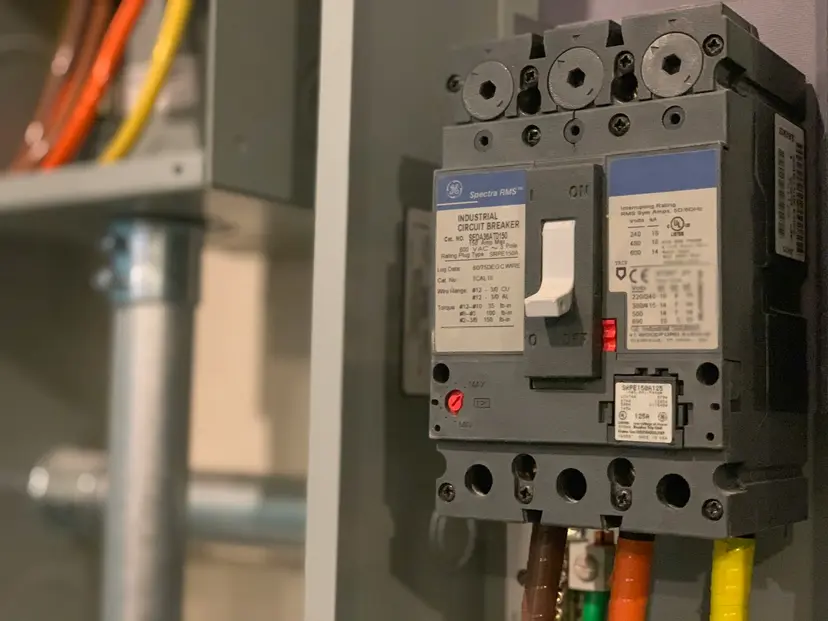
- Photo by Jonathan Hanna on Unsplash
⭐ Was this article helpful?
IDAR Mohamed
Electrical Engineer
Electrical Engineer specialized in power systems, electrical installations, and energy efficiency. Passionate about simplifying complex electrical concepts into practical guides. (University of applied sciences graduate, with experience in HV/LV systems and industrial installations.)
- Single-Phase vs Three-Phase
- Motors and Drives
- Power Factor
- Efficiency and Losses