

Difference Between Grounding and Earthing: Complete Guide with Wiring Examples & NEC Code Requirements
- Admin: IDAR Mohamed
- 15 Dec 2024
- 0
The confusion between grounding, earthing, and neutral causes more electrical mistakes than almost any other concept in electrical work. Even experienced electricians sometimes use these terms interchangeably, but understanding their distinct differences is crucial for safe installations, proper code compliance, and preventing costly electrical failures.
Whether you're installing new electrical services, troubleshooting ground fault issues, or ensuring NEC compliance in your electrical projects, mastering these fundamental concepts will elevate your electrical knowledge and improve installation safety.
Understanding Grounding vs Earthing vs Neutral: Core Definitions
The difference between grounding and earthing lies in their specific purposes and connection methods, while neutral serves an entirely different function in electrical systems.
What is Earthing? (Safety-First Protection)
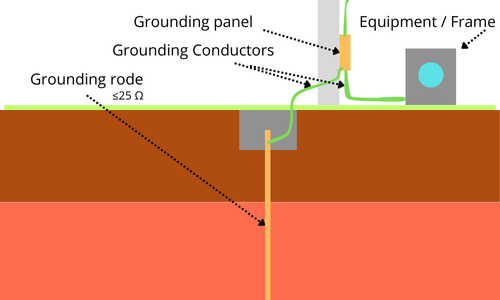
Earthing refers to the direct physical connection of electrical equipment or systems to the actual earth through conductive materials like ground rods, plates, or grids.
Primary Functions:
- Fault current path: Provides low-impedance path for fault currents
- Lightning protection: Safely dissipates lightning strikes and surges
- Static discharge: Prevents static electricity accumulation
- Voltage stabilization: Maintains earth as zero potential reference
Physical Implementation:
- Ground rods driven into earth
- Grounding grids buried in soil
- Metal water pipe connections
- Concrete-encased electrodes (Ufer grounds)
What is Grounding? (System Reference Point)
Grounding establishes a reference point (typically zero volts) for electrical systems and includes both safety and functional aspects.
Key Functions:
- Reference potential: Provides stable voltage reference for systems
- Equipment protection: Connects non-current-carrying metal parts
- System grounding: Connects neutral points of transformers and generators
- Noise reduction: Provides return path for electrical interference
Types of Grounding:
- System Grounding: Connects the neutral point to ground
- Equipment Grounding: Connects equipment frames and enclosures
- Static Grounding: Prevents static electricity buildup
- Signal Grounding: Provides reference for electronic circuits
What is Neutral? (Current Return Path)
The neutral conductor carries return current during normal circuit operation and completes the electrical circuit.
Essential Characteristics:
- Current carrying: Designed to carry unbalanced current
- Voltage level: Normally at or near ground potential
- Color coding: White or gray insulation (NEC requirements)
- Connection point: Bonded to ground only at service entrance
info
Key Distinction: Neutral carries current during normal operation, while grounding conductors should only carry current during fault conditions.
NEC Code Requirements and Standards
Article 250: Grounding and Bonding
The National Electrical Code (NEC) Article 250 governs all grounding and bonding requirements in electrical installations.
Grounding Electrode System Requirements (NEC 250.50)
Mandatory Electrodes (when present):
- Metal water pipe (NEC 250.52(A)(1))
- Structural metal frame (NEC 250.52(A)(2))
- Concrete-encased electrode (NEC 250.52(A)(3))
- Ground ring (NEC 250.52(A)(4))
Supplemental Electrodes (when required):
- Ground rods (NEC 250.52(A)(5))
- Ground plates (NEC 250.52(A)(7))
Ground Rod Installation Requirements
| Specification | NEC Requirement | Notes |
|---|---|---|
| Minimum Length | 8 feet | NEC 250.52(A)(5) |
| Minimum Diameter | 5/8 inch | For steel rods |
| Material | Copper, galvanized steel | Copper-clad acceptable |
| Burial Depth | 8 feet minimum | Top must be flush or below grade |
| Spacing | 6 feet minimum | Between multiple rods |
| Resistance | 25 ohms maximum | If exceeded, install second rod |
Grounding Electrode Conductor Sizing (NEC Table 250.66)
Based on largest service entrance conductor:
| Service Conductor Size | Copper GEC | Aluminum GEC |
|---|---|---|
| 2 AWG or smaller | 8 AWG | 6 AWG |
| 1 AWG or 1/0 AWG | 6 AWG | 4 AWG |
| 2/0 or 3/0 AWG | 4 AWG | 2 AWG |
| Over 3/0 thru 350 kcmil | 2 AWG | 1/0 AWG |
| Over 350 thru 600 kcmil | 1/0 AWG | 3/0 AWG |
Equipment Grounding Conductor Sizing (NEC Table 250.122)
Equipment grounding conductors must be sized according to the overcurrent protective device:
| Circuit Breaker Rating | Copper EGC | Aluminum EGC |
|---|---|---|
| 15A | 14 AWG | 12 AWG |
| 20A | 12 AWG | 10 AWG |
| 30A | 10 AWG | 8 AWG |
| 40A | 10 AWG | 8 AWG |
| 60A | 10 AWG | 8 AWG |
| 100A | 8 AWG | 6 AWG |
| 200A | 6 AWG | 4 AWG |
Step-by-Step Installation Examples
Example 1: Residential Service Grounding System
Let's design a complete grounding system for a 200A residential service installation.
Given Parameters:
- Service: 200A, 240V, single-phase
- Service conductors: 3/0 AWG copper
- Available electrodes: Metal water pipe, concrete foundation
- Soil conditions: Average conductivity
Step 1: Determine Grounding Electrode Requirements
Available Electrodes to Bond:
- Metal underground water pipe (>10 feet)
- Concrete-encased electrode (Ufer ground)
- Supplemental ground rod (required if only metal water pipe)
Step 2: Size Grounding Electrode Conductor
From NEC Table 250.66 with 3/0 AWG service conductors:
- Required GEC: #4 AWG copper minimum
- Connection: Exothermic weld or listed clamp
Step 3: Calculate Ground Rod Requirements
Single Rod Test:
- Install 8-foot ground rod
- Measure resistance using fall-of-potential method
- If resistance ≤ 25 ohms: Installation complete
- If resistance > 25 ohms: Install second rod 6+ feet away
Estimated Resistance Calculation: For 8-foot rod in average soil (100 Ω⋅m resistivity):
Where:
- ρ = soil resistivity (100 Ω⋅m)
- L = rod length (8 feet = 2.44m)
- a = rod radius (0.0079m for 5/8" rod)
Result: Resistance exceeds 25Ω, so second rod required.
Step 4: Design Final Grounding System
Complete Installation:
- Ufer ground: #4 AWG in concrete foundation
- Water pipe bond: #4 AWG to metal water pipe
- Two ground rods: 8-foot rods, 6+ feet apart
- Rod conductors: #6 AWG to each rod (NEC 250.53(E))
- Main bonding jumper: Size per NEC 250.28
Example 2: Industrial Equipment Grounding
Scenario: 480V Motor Installation
Equipment Details:
- Motor: 50 HP, 480V, 3-phase
- Feeder: 100A circuit breaker
- Conduit: Rigid metal conduit
- Distance: 150 feet from panel
Step 1: Determine Equipment Grounding Requirements
Equipment Grounding Conductor (EGC): From NEC Table 250.122 for 100A overcurrent device:
- Required EGC: 8 AWG copper minimum
Step 2: Calculate Voltage Drop in EGC
For fault current calculations, EGC resistance must be considered:
EGC Resistance:
- Conductor: 8 AWG copper
- Resistance: 0.628 Ω/1000ft at 75°C
- Length: 150 feet one-way
- Total resistance: 0.628 × 150/1000 = 0.094 Ω
Step 3: Verify Fault Current Path
Available Fault Current at Panel: 10,000A (given) Impedance of fault path: 0.094 Ω (EGC) + 0.05 Ω (connections) = 0.144 Ω
Fault Current through EGC:
Breaker Operating Time: 100A breaker trips in <0.1 seconds for 1,927A fault current.
Result: EGC properly sized for fault protection. ✓
Advanced Grounding Applications
Data Center and IT Equipment Grounding
Modern data centers require specialized grounding approaches:
Signal Reference Grid (SRG)
- Purpose: Provides equipotential plane for sensitive equipment
- Construction: Copper mesh grid under raised floor
- Connection: Bonded to main grounding electrode system
- Resistance: <1 ohm between any two points
Isolated Ground Systems
For sensitive electronic equipment:
- Dedicated EGC: Runs with circuit conductors
- Isolated Ground Receptacles: Orange in color
- Connection: Back to main panel only
- Purpose: Reduces electrical noise
Lightning Protection Integration
Grounding systems must coordinate with lightning protection:
Air Terminal Systems
- Down conductors: Minimum 2/0 AWG copper
- Ground terminations: Multiple electrodes
- Bonding: All grounds bonded together
- Resistance: <10 ohms preferred
Cathodic Protection Considerations
In areas with cathodic protection systems:
- Isolation: May require dielectric unions
- Coordination: Work with pipeline protection engineers
- Testing: Special procedures for ground resistance
Practical Installation Procedures
Ground Resistance Testing Methods
Fall-of-Potential Method (3-Point Test)
Most accurate method for measuring ground resistance:
Equipment Required:
- Ground resistance tester
- Test leads and electrodes
- Distance measuring device
Procedure:
- Current electrode (C2): Place at 2.5 × rod length from ground rod
- Potential electrode (P2): Place at 62% distance between ground rod and C2
- Measurement: Connect tester and measure resistance
- Verification: Move P2 ±10% and remeasure
Standard Test Distances:
- 8-foot rod: C2 at 200 feet, P2 at 124 feet
- Acceptable variation: P2 between 110-140 feet
- Results should vary <5% for accurate reading
Clamp-on Method
For existing installations with multiple ground paths:
- Advantage: No disconnection required
- Limitation: Requires multiple ground paths
- Accuracy: ±10% typically
- Applications: Routine testing, troubleshooting
Common Installation Mistakes and Solutions
Mistake 1: Improper Neutral-Ground Bonding
Problem: Bonding neutral and ground at sub-panels Code Violation: NEC 250.142(B) Consequences:
- Ground fault current through neutral
- Voltage on equipment frames
- Nuisance GFCI trips
Solution:
- Remove bond at sub-panels
- Install floating neutral bar
- Verify with voltage measurements
Mistake 2: Inadequate Ground Rod Installation
Problem: Rod not driven to required depth Common Issues:
- Rod hitting rock or underground utilities
- Only 6 feet driven instead of 8 feet
- Improper connection methods
Solutions:
- Use alternative electrode types (plates, chemical rods)
- Install at angle (max 45°) if necessary
- Use listed connections (exothermic welds, compression clamps)
Mistake 3: Incorrect EGC Sizing
Problem: Using circuit conductor size instead of Table 250.122 Example Error:
- 60A circuit with 6 AWG conductors
- Installing 6 EGC instead of required 10 AWG
Correction: Always use Table 250.122 based on OCPD rating
Ground Fault Protection Systems
Ground Fault Circuit Interrupters (GFCI)
Operating Principle:
- Monitors current imbalance between hot and neutral
- Trips when imbalance exceeds 4-6 milliamps
- Provides personnel protection
Installation Requirements:
- All bathrooms, kitchens, outdoor outlets
- Crawl spaces, unfinished basements
- Garages and accessory buildings
Ground Fault Protection of Equipment (GFPE)
For larger systems (>1000A services):
- Trip setting: 1200A maximum
- Time delay: Coordinated with downstream devices
- Purpose: Equipment protection, not personnel
Troubleshooting Grounding Problems
Diagnostic Procedures
High Ground Resistance Issues
Symptoms:
- Ground resistance testing >25 ohms
- Equipment operating at elevated voltages
- Electrical noise in sensitive equipment
Diagnostic Steps:
- Visual inspection: Check all connections
- Individual electrode testing: Test each electrode separately
- Soil resistivity measurement: Determine if additional electrodes needed
- Connection integrity: Check for corrosion, loose connections
Solutions:
- Install additional ground rods
- Use chemical enhancement materials
- Consider ground plates or grids
- Improve connection methods
Ground Loop Problems
Symptoms:
- 60 Hz hum in audio/video equipment
- Erratic operation of electronic devices
- Multiple ground reference points
Solutions:
- Single-point grounding approach
- Isolated ground circuits for sensitive equipment
- Proper cable shielding and routing
Testing and Verification
Required Tests
- Continuity testing: Verify all ground connections
- Ground resistance measurement: Confirm <25 ohm requirement
- Voltage testing: Check for improper neutral-ground bonds
- Insulation resistance: Verify conductor integrity
Documentation Requirements
- Test results: Record all measurements
- Installation photos: Document electrode locations
- As-built drawings: Show actual installation details
- Maintenance records: Track periodic testing
System Integration and Coordination
Coordinating Multiple Ground Systems
Modern electrical installations often include multiple grounding systems that must work together:
Telecommunications Grounding
Requirements (per TIA-607):
- Telecommunications Grounding Busbar (TGB): Minimum 1/4" × 4" copper
- Bonding Conductor: #6 AWG minimum to electrical ground
- Resistance: <1 ohm between systems
Fire Alarm System Grounding
Special Considerations:
- Dedicated ground fault monitoring
- Isolation from other systems during fault conditions
- Coordination with sprinkler system grounding
Power Quality Considerations
Proper grounding affects power quality significantly:
Harmonic Mitigation
- Neutral conductor sizing: Handle harmonic currents
- Ground reference: Stable for electronic loads
- EMI reduction: Proper grounding reduces electromagnetic interference
Transient Suppression
- Surge protective devices: Require effective grounding
- Transient voltage surge suppressors: Ground reference critical
- Lightning protection coordination: Integrated approach needed
Economic and Safety Analysis
Cost-Benefit Analysis of Proper Grounding
Initial Investment vs. Long-term Savings
Quality Grounding System Costs:
- Ground rods and materials: $200-500
- Professional installation: $500-1,200
- Testing and documentation: $200-400
- Total: $900-2,100
Costs of Inadequate Grounding:
- Equipment damage from faults: $5,000-50,000+
- Electrical fires and insurance claims: $100,000+
- Code violations and re-work: $2,000-10,000
- Personal injury liability: Unlimited
info
Return on Investment: Proper grounding systems typically pay for themselves by preventing a single equipment failure or safety incident.
Insurance and Liability Considerations
- Many insurance policies require NEC compliance
- Inadequate grounding can void coverage
- Professional liability for electrical contractors
- OSHA requirements for workplace safety
Future Technologies and Standards
Smart Grid Integration
Modern grounding systems must accommodate:
- Distributed generation: Solar panel grounding requirements
- Energy storage systems: Battery grounding and bonding
- Electric vehicle charging: Specialized equipment grounding
- Smart meters: Communication system grounding
Emerging Standards
- IEEE 142: Green Book updates for industrial grounding
- NEC updates: Continuous evolution of grounding requirements
- IES standards: International harmonization efforts
- UL listing requirements: Updated equipment standards
Conclusion: Mastering Electrical Grounding Systems
Understanding the fundamental differences between grounding, earthing, and neutral conductors is essential for any electrical professional. These concepts form the foundation of electrical safety and proper system operation, from simple residential installations to complex industrial facilities.
Key Takeaways:
- Earthing provides safety through direct earth connection
- Grounding establishes system reference and equipment protection
- Neutral carries return current during normal operation
- All three systems work together but serve distinct purposes
- Proper installation requires attention to NEC requirements and testing
- System integration becomes increasingly important in modern installations
Whether you're working on electrical service installations, designing motor control circuits, or troubleshooting GFCI problems, mastering these grounding principles will improve both safety and system reliability.
The investment in proper grounding systems pays dividends in equipment protection, personnel safety, and code compliance. As electrical systems become more complex and sensitive, the importance of well-designed grounding systems only continues to grow.
Ready to deepen your electrical expertise? Explore our comprehensive guides on advanced electrical topics and stay current with evolving safety standards and installation practices.
🔗 Related Posts
- Wire Size Calculator: Complete Guide with Single Phase, 3-Phase & DC Calculations
- Circuit Breaker Sizing: Complete Guide with Wire Size Charts & NEC Code Requirements
- Complete Guide to Voltage Drop: Calculations, Tables & Calculators
- MCB vs MCCB: Complete Comparison Guide with Selection Criteria, Ratings & Applications
- Kirchhoff's Laws: Complete Guide with Circuit Analysis Examples & Calculations
Helpful Calculators
- Voltage Drop Calculator
- Ohm's Law Calculator
- Power Factor Calculator
- Capacitor and Inductor Reactance Calculator
Standards and References
- NEC Article 250: Grounding and Bonding
- IEEE 142: Green Book - Grounding of Industrial and Commercial Power Systems
- IEEE 80: Guide for Safety in AC Substation Grounding
- NFPA 70: National Electrical Code
- UL 467: Standard for Grounding and Bonding Equipment
Credits
- Photo by Hobi industri on Unsplash
⭐ Was this article helpful?
IDAR Mohamed
Electrical Engineer
Electrical Engineer specialized in power systems, electrical installations, and energy efficiency. Passionate about simplifying complex electrical concepts into practical guides. (University of applied sciences graduate, with experience in HV/LV systems and industrial installations.)
- Grounding
- Earthing
- Neutral Wire
- Electrical Safety
- Ground vs Neutral
- Electrical Wiring
- NEC Code
- Electrical Installation
- Electrical Grounding
- Circuit Protection